Tuesday, November 15, 2005

Things I Googled This Week

And by "this week," I mean "since Sunday." (It very much feels like a late Thursday.)

I thought I would just list some of the things I've googled this week for the entertainment of the thing, but as I made the list, I realized that one could get a pretty good picture of my week just by seeing what I've been googling. And so, la la, my week in google search terms.

define discordant - Not an auspicious beginning to my week.

how make silk for clothes - Apparently, from a caterpillar, not an actual worm. (The vegetarian website I found that detailed the process noted that the caterpillars have to be killed before they emerge from their cocoons for the best silk.) Consider: the new shirt I bought is silk and rabbit hair.

J Reuben Clark student conference - In February. In DC. La, I'm going.

Lady Duff Gordon (aka Lady Duff-Gordon) - Was the defendant in a case we read in contracts. Also, a huge early 20th-century celebrity, fashion designer, businesswoman. And was on the first raft of people saved from the Titanic. (Her husband and her maid was saved, too.)

Elinor Glyn - First try

Elinor Glin
- Sister to Lady Duff Gordon. Went from the English lower class to Hollywood elite by writing novels, especially trashy romance novels that scandalized the monarchy. Coined the term the "It-Girl."

GK Chesterton Quotes
- Notably, "It is not bigotry to be certain we are right; but it is bigotry to be unable to imagine how we might possibly have gone wrong." AND "Poets have been mysteriously silent on the subject of cheese."

apply to be an astronaut - Because a new Stanford friend is actually going to apply when she turns 26 next year. (I can't any longer--I've had LASIK. I'm working through it.)

claustraphobia
- claustrophobia

epicurious
- See next entry

gourmet stuffing recipe
- Because I'm getting excited for Thanksgiving. (I'm on Stuffing Detail.)

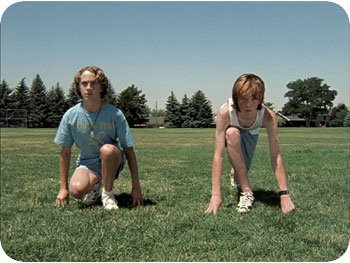
moxie pictures - www.moxiepictures.com > Directors > Jared Hess > the picture of the two crouching boys. Brother Nate pointed me here, and I've been directing friends to it (and inexplicably forgetting the actual URL) all week.


chicken soup dickinson
- I have this theory that Emily Dickinson has a poem about everything. And I wanted one about or involving chicken soup.

poem "chicken soup"
- Because I realized I needed to broaden my search and modify my theory.

poem "chicken soup" -soul
- Because I wanted a poem that wasn't meant to warm teeangers' hearts.

set alarm
- I didn't believe I would be able to wake up to my cellphone alarm in order to do work before class on Monday, so I looked for an alarm clock I could set online. I think I found one, but it was too smart for me. So I went to bed and took my chances.

comedy warmups
- To prep for Monday's on-campus FHE of improv comedy games. The goldmine: The Shootout (a game involving tragic deaths and cowboy firearms).

capitalize LASIK
- For some law school-related reason I wanted to know if LASIK needed to be in all-caps or if just a first-letter magiscule was more appropriate. I don't know what's right, but I do know a lot of people are "capitalizing" on things related to LASIK.

utah state teaching license
- I was trying to figure out the technical name of my teaching license to put on my resume. I couldn't. I didn't.

words with all vowels
- Like "facetious" or "abstemious" (which have all the vowels in order). Assuming we exempt Y (or add an adverbial -ly ending). And W. (Not strictly a vowel. At least, most of my section agrees. But Daniel Elizondo, he will hold out.)

magiscule
- I couldn't even post this blog without googling. I'm hooked. See LASIK above.

Friday, November 11, 2005

What's Funny Is Funny

Jane, friend and Stanford undergrad, recently has begun feeding me stories wherein international power meets human quirkiness. The most recent deserves its own blog. Jane saiden:

So the President of Turkmenistan renamed all of the months after family members/national heroes. The month of April was "Mother."

This was done in August 2002.

Picture of Turkmeni President Saparmurat Niyazov:


Robespierre (whom I call 'Robie') also renamed all the months, didn't he? They look alike, actually... (white hair, dark eyebrows, same 'smile,' similar suit, white shirt underneath, etc)

Robie:


Oh, power. "We have learned by sad experience that it is the nature and disposition of almost all men, as soon as they get a little authority..." what, to rename the months of the year? Of all the things to do with power, HONESTLY. Have a pancake fest, or SOMETHING!! Crazy world, blast it all.

Thursday, November 10, 2005

I've always like the word "Moabitish."

My Favoritish Books

Victor Monreal, Austinite friend, collects lists of people's favorite books. Recently, he requested mine with attendant summaries. I'm opening myself to all kinds of liability listing these for all the world to see. They're perhaps too sentimental, too Western, and too juvenile for an English major to conscionably list as her favorite. You should know, I also haven't read Moby Dick.

In the order I thought of them to write them down:

The English Patient by Michael Ondaatje
Perhaps the most beautiful book I've ever read. As I read it, I kept thinking, "I can't believe someone wrote this. I can't believe some one wrote this." About four people in Italy in late WWII after the Italian fighting was largely over. Feels, however, very WWI.

The Living by Annie Dillard
About 19th-century pioneers in Bellingham, Washington. Called a novel, but every sentence reeks of human detail Annie could not have invented. It's about the living--felling trees, eating food, digging wells, and about the living--those left alive. Super beautiful.

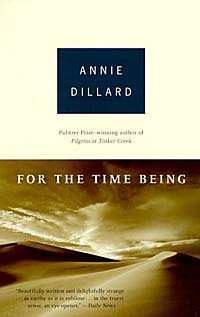
For the Time Being by Annie Dillard
Technically and effectively my favorite book. It's a collection of short essays about sand, clouds, birth, China, Jews, humanity, etc., that deal with what it means to be one of a billion billion things in the eyes of God.

The Little Prince by Antoine de Saint-Exupery
Short, childlike. Very nearly a perfect book about a little prince who falls from a comet to earth and meets a pilot in the desert. Translated from the French.

Sarah, Plain and Tall by Patricia MacLachlan
Perfect. Slim, simple. About Caleb and Anna, two children growing up on the plains, who must welcome a Maine woman into their home when their quiet widower father advertises for a wife.

The Blue Castle by LM Montgomery
Invariably the cover of the book will be terrible, like a trashy teenage Harlequi This is the only adult novel written by the author of Anne of Green Gables, "adult" meaning it has (a) a swear word and (b) no children. About a 29-year-old old maid who, when diagnosed with a fatal heart condition, decides to say and do the things she's always wanted, to the horror of her prideful and prim early 20th-century family. I read it yearly, maybe more.

The Island by Gary Paulsen
About a teenage boy who decides to move to the island of a small nearby lake, to think and read and write and draw.

Ender’s Game by Orson Scott Card
The classic sci-fi novel about a brilliant child (Ender) sent to Battle School to learn how to save the world from the Third Invasion. The crux--in order to destroy something, Ender needs to know it as well as it knows itself. And as soon as Ender knows it well, he loves it but must destroy it. I plan on reading it every year until I die.

Monday, October 31, 2005

To McSweeney's, With Love

The following is from a Saturday email to a friend (who oft looks uncannily like Gilbert Blythe and others times--less oft but more recently--like a rebel beach bum without a cause), himself a master blogster: www.sweetlemon24.blogspot.com

(Note: I'm desiring enough to be a regular blogster that I'm going to steal from my own emails. Maybe just this once. Maybe again, too. I know--I never write, I never call, I never leave a message.)


Let's be honest. There's a good chance you've considered all of the following things. But I just had a moment, lying almost flat on my back in my bed in my room, with my head propped up on two pillows and chin resting on my chest, laptop on my lap, which was formed by my knees being propped and bent so-and-so (are you with me?), laughing. I laughed aloud, more than once, more than once.

So, consider.

http://www.ericdsnider.com/blog.php

(which I found from following your link to stupidramblings to his link to Eric Snider's blog)--the entry for Oct. 7 and its attendant link to

http://www.mcsweeneys.net/links/lists/30CraigRobertson.html .

Which is especially funny because today, when brainstorming with a friend for his Halloween costume, I came across the same website, different entry, and laughed and laughed. (Maybe I just laughed once.)

http://www.mcsweeneys.net/1999/10/31halloween.html

This entry I found because we typed in "halloween costume ideas" or something, and the first three or four pages were (a) silly and (b) the first three or four pages. (In other words, if he'd pulled a costume idea from these pages, and someone else in the ward had also googled for costume ideas and had seen his idea, then it would be a let-down, a disappointment, not a triumph.) So I picked a random high number in the page links (like 9 or something) and la la, McSweeney's.

Heavens, I'm sick. (Literally so.) Which is why I'm convalescing (and lying in bed) on a Saturday afternoon. Let's also ascribe said sickness to my lack of (a) coherence and (b) punch.

Saturday, October 29, 2005

Ergo

A short story about the word "ergo."

Ergo is a word I like. I began to use it some time ago but didn't seem to notice much of a response from listeners and would-be listeners. This was okay with me in a singing-to-myself sort of way. One evening last summer, two or three hours into an LSAT prep session at Meridian High, I sat stretched out on an old blue couch in the German classroom where we met, and I said to my teacher (Brent Dunn, family friend and acelsat himself) with an entire class of would-be LSAT-takers as would-be listeners, "Something something something, ergo..." And when I was finished with my comment, Jeff, my would-be friend and erstwhile ride, leaned over to me and whispered distinctly and with an advisorial air: "Don't use 'ergo.' It's antiquated." I almost laughlaughed right then. But I didn't because he'd leaned so close to me, I would have laughed in his face.

I can neither describe nor explain how much I want to hold that sentence in my hands and show it to people. So sometimes I say it to myself as I lie down at night. I try to whisper it like Jeff did. "Don't use 'ergo.' It's antiquated."

Wednesday, August 24, 2005

The Pursuit for Professional: Part I: Luggage

There's a distinct possibility that, by week's end, I'll be the new owner of luggage, a suit, and leather heels.

I. Luggage

I bought luggage this morning. I got my first set of luggage (a forest green, $100 Costco set I loved) when I was 18. I felt like an adult having that luggage--matching, versatile, utile. But it died after twelve or so transcontinental Salt Lake-to-NY flights, and I've been pretending for the last three years that I can live without luggage. Can do without it. (See imaginarily attached diagram of garbage sack, canvas bag, Beth Hedengren-donated backpack, duct-taped boxed contraptions.) But I'm heading off to law school (tomorrow on a plane to see my best friend, Laura A. T. and co.) and to a new life. And I needed luggage.

I've traveled a lot this summer (see previous blog) and so have spent some moments--on beds, airplanes, trains, buses, ferries, and a moped; in beds, cars, taxis, subways; at baggage carousels and open trunks around the world--considering what my ideal set of luggage would be.

Four pieces: (1) giant suitcase, (2) normal large suitcase, (3) large duffel bag (similar size as normal large suitcase), and (4) roller-board carryon. All with pockets. All with wheels and straps and handles and zippers (strong, strong zippers). And red.

That's really all there is to my story, except the important part, which is to say I bought it this morning, with fake money I don't have but have budgeted for, on an impulse stop at Village Luggage (villageluggage.com, supposedly), which Mom and Peter and I passed on our way to donate blood. Apparently people do shop at those fairly easy-to-miss stores throughout Long Island. (Peter asked: "How do they ever make money?" And I said: "They've been open today for six minutes, and I just spent $300.") I did not, however, buy the roller-board carryon, which would have been an additional $80 plus tax. (Though I did get a compl(e/i)mentary tote.) And it's all monogrammed--SLO. S L O. Which will, I suppose, work better than my first plan, which was to identify my luggage by a faded blue and orange handkerchief (aka doo rag) from girls' camp of yore I was otherwise going to tie to the bags. Though, to be professional, I maybe could have convinced myself to purchase a new one. In silk.

Saturday, July 23, 2005

I should be heading out AKA The Official Sarah Update

I. Justification & Background
It's 12:46, and according to mapquest, it will take me 5 h 40 m to get to Geneva, NY, where I will be an EFY counselor beginning tonight, tomorrow, or Monday at 11 am (depending on your rounding practices). What I'm saying is, I need to go.

But I've received two requests recently for blog updates (Jackie, m'love, and Victor) and two is enough for me. At least for now.

I've had some thoughts about the unhelpfulness of blog writing recently, about its dash-and-go flavors, its implicit though subtle reinforcement of our society's move away from encouraging reflection, craftmanship, etc etc. I acknowledge that these thoughts may serve primarily to justify my lack of consistency and to excuse myself for feeling slightly nauseated every time I read one of my blog entries. But if you know what I mean, you know what I mean. I'm having faith in the blogging whatnot.

II. The Update AKA Sarah's Summer/Life Plans

May 2005 Sarah finished the master's thesis (el these), uncreatively titled "Metaphor and Inquiry." 83 pages, or something.

May-endish Sarah graduated with an MA in Curriculum & Instruction from UT-Austin, Pres. Hinckley came to TX for the San Antonio Temple Jubilee, and Olson parents and Anika were in Austin for all festivities.

May 31ish Sarah flew to NY and then to England for to see Stacey Snider, former roommate and BYU friend, who was studying at the University of Nottingham.

Early-Juneish Sarah and Stacey flew to Ireland for six of the most beautiful, most relaxing, most most days of lovely Irish mostness of all time and most. So beautiful.

Late-Juneish Sarah flew to Austin.

June-endish Sarah took Greyhound to Denton, TX, to be an EFY counselor. Then, a week later, she came home.

July 3 Sarah flew to Seattle to visit Stacey Snider (newly returned from the UK). Sarah and Stacey, the next day or the next, visited Friday Harbor and Bellingham and one of the great grocery stores of all time.

July 5thish Sarah and Stacey met up with Ryan Gee (boyfriend) and family in Seattle to poke in the Old Curiosity Shop and hand Sarah off.

July-middish Sarah and Ryan and Gees attended the Sis. Gee family (Arvidsen) family reunion in Oregon, in the forest, in the rain, in the mud, near the waterfalls.

July-middish Sarah's family arrives in Oregon, visits with the Gees and the Arvidsens for an hour or so, and Olsons and Sarah and Ryan head to Eugene to meet with up with the Sis. Olson family (Hoggards) for their family reunion. The Hoggards head to Florence, OR, to spend two days on the Oregon coast, playing the super cold water, wearing their "Hoggard's Yardbirds" polo shirts, and eating (eating) eating food.

July-midmiddish Sarah and the lesser immediate Olsons begin cross-country trek that will be its own blog, if not its own essay. They hit Boise, Salt Lake, the Four Corners, Albuquerque, Austin, Tyler, Birmingham, Atlanta, the entire midatlantic coastal states, and end up in NY. Almost 5,000 miles in 8 days, or something.

This morning, July 23 at 12:15 am The Olsons arrive home intact.

Today, July 23 Sarah is off to Geneva, NY, for one last week of EFY, which departure is being delayed by the writing of this blog.

But no more. Well, a little more.

Sarah will return to Valley Stream for the month of August (with a week to Austin for Martha and Abdul's wedding and such), before heading to California on August 29th to begin her (miracle, miracle) years at Stanford Law School. La la.

(P.S. Did you notice how I changed tenses and points-of-view in this blog? Blogging. Like writing on fast food napkins. Without the self-effacing charm.)

Friday, September 17, 2004

From Inside Sarah's School Head

After a phenomenal dryspell (and more cross-country driving than an episode of the Partridge family), I am using my blog for two ends:

(1) to remind myself that I can post things and live a virtual and actual life simultaneously
and
(2) to regroup before I meet with my master's thesis advisor at 2. In 18 minutes.

So, to cut to the chase:

I have a master's thesis advisor named Dr. Colleen Fairbanks. We don't know each other at all on a personal (or professional level, really), but we met two weeks ago to get started on the year (I'm taking a 3-credit thesis writing independent stuffstuff course) and to get me working towards actually completing this project in time for May graduation.

She asked a few questions, and we talkedtalked. She suggested books, and I wrote stuff down. And we parted.

And this is what I did in the middle--I read most of Children's Inquiry by Judith Lindfors (who turns out to be a UT professor--or was) and read a few chapters from Curriculum as Conversation by Arthur Applebee (who, as it turns out, is married to another eminent English teaching scholar/academic, Judith Langer. Exactly.). Additionally, I did hours (brief hours, but hours nonetheless) of research to find articles about both student questioning and metaphors/education, primarily for an annotated bibliography assignment I had to complete for one my classes. But from all of this stuff, I learned the following:

1. I don't think I'm interested in students' asking questions, at least as far as my thesis goes. I really am more interested in the use of metaphors pedagogically, or, at least, in the classroom. And not as part of a lesson on figurative language. But as part of how we make sense of the world around us.
2. I think I'm interested more in explicit metaphors than in implicit ones (as made famous by Lakoff and Johnson's Metaphors We Live By, which exposed, apparently, that most of our language and consequently, our conceptions of the world, are (in)formed by metaphors and metaphorical thinking).
3. I am interested in explicit metaphors but, more specifically, the creation of them as acts of inquiry, as tentative explorations of things we almost know but don't quite.

In short, I think that I want to begin to think about my thesis in terms of metaphors and acts of inquiry. I don't know if this is legitimate, but maybe I can take the research (Lindfors' especially; her book was very much something I would like to write, but a little technicaler than I want to be) that discusses inquiry--defines, categorizes, and encourages it in classroom use--and discuss how metaphor, and not just questions and not just authentic interests and not just problem-based learning, can be (is! is!) an act of inquiry. And, consequently, is something we should help students learn how to craft. Or, at least, it is something we need to inspect more closely.

Something like that?

The thesis will be theory. This excites me. But I may, too, need some texts (of students and teachers discussing/using metaphors) to analyze. Will I have to collect them myself? Will I have to get human subjects approval? Does that change my timeline?

It's 1:53 pm. These are things I'm thinking about. These things and, as always, fajitas.

Wednesday, August 11, 2004

Last Dance OR "Who Ran Four Miles? I Did!"

Part I
I was in middle school when I first personally encountered the concept of the Last Dance. I wasn't aware that it was a Thing (so unaware, that the first time I heard the song "Last Dance," I thought, "Cool."). But it was, all by itself, dramatic. The drama of the evening, the delay of seeking out the one boy, the back and forth and trips to the water fountain, etc., were all intentionally part of the intentional procrastinating of the evening's climax. And then, wham, it would strike us/me that we/I were coming up soon to the last dance, the Last Dance, and that all our hopes and dreams and fears would either realize themselves (or not), and this dance would either be a dance among men (or not).

And then, at my first middle school dance, they actually played "The Last Dance," the crime against music that is essentially a practical joke. The first thirty seconds are, you remember, slow. Slow, for just long enough for you to seek out (if you're brave) the boy you want to dance with and to begin working through those awkward first dancing moments, arms on his shoulders, hands around her waist (or on her hips). Slow for just long enough until the beat picks up, and it's a fast dance.

Cruel.

(Though, to be honest with you, I was never actually caught in it. I just watched the devastated uncomfortability it wreaked.)

All of that was a really inappropriate buildup for this: it is my last day at work in Provo.

Part II
Grandma and Grandpa take me out for lunch this afternoon, I come back to work, do my last run, do my last errands, have my last Cafe Rio, and then tomorrow, midday, Dave Hedengren (my to-Kansas driving partner) and I drive off into the proverbial sunset.

And it's worth noting--in fact, it's the reason I wrote this--that while this summer, I spent a lot of time not seeking people out (for which I apologize), and while I didn't get as much sleep as I should have (Stacey...Marisa...The West Wing...), I did read my scriptures, I did go to LSAT prep--every time I was supposed to, I did go to the temple weekly, and I did--are you ready?--reach my running goals.

I ran four miles--four miles--twice. Two days in a row. Me, Monday, four miles, no stopping. Me, Tuesday, four miles, no stopping.

And I have to tell you, it's like proverbial icing on the cake.

The Sum Up
In short, I haven't danced with a boy this summer and that doesn't worry or sadden me. So, my whole Last Dance intro was really a red herring. But I have run, and run and run and run, and finally, in the end, I ran just as long as I have wanted to. Four miles, non-stop, twice. And that's my story. And my summer.

Tuesday, August 10, 2004

My Own Private Mecca, or How to Get to a Natural Water Playground

My friends and I ran away a weekend or so ago and found ourselves at our target destination, which, to my delight, turned out to be my dream-come-true of a nature spot.

It's a natural waterslide and rivery system, up in the foothills of the Alpine Mountains. You can go, for free, and 20, 30, 40 minutes later, you're sliding down a natural waterslide, that doesn't hurt, that lets you go fast, that drops you off into an almost clear pool of mountain water on sandy, pebbly bottom.

And you can climb all you want, up the rocks, over the rocks, through the water, under the waterfalls. And you can explore and sit and think and feel like a country music album cover.

It's just such a great time that I'm hesitant to talk about it (despite my recent proselyting) because I haven't yet found the right words to explain it.

Everyone should go. And I'm including the directions below. (Note: They don't seem straightforward, but I went only once, and I've since been able to find it again myself and explain, on the phone, to someone else how to get there. It's not a difficult path; it's just without significant markers.)

Directions
1. Travel on I-15. (This is in Utah.)
2. Take the American Fork 500 East exit.
3. Go R on 500 East.
4. Turn L at the first major intersection (not the one by Carl's Jr.).
5. Go R on 100 East.
6. 100 East will turn into Hwy 74, Main Street in Alpine, and Alpine Highway. Stay on this road until you're done. On 100 East, you'll pass the Alpine School District office, the American Fork cemetary on your left, some developments and goats on your right, Lone Peak High School on your left, and eventually you'll come into some stop sign streetness. Keep going straight.
7. The road will eventually hit a roundabout. At the roundabout, do a 180, and head towards the chiropractor's office building (it should have a big sign on it). Keep heading on Alpine Highway.Eventually this road will start curving to your left. It will curve around, become windy, become narrow.
8. At some point, you'll see a really large gray house to your left. It has a big lawn. You might say to yourself, "Wow, that's a big lawn." Right after that, there will be a random farm-looking gate on the left side of the road. This is the entrance.
9. You can either park outside this gate on the side of the road and hike up (which is what I've done thus far), or you can do what all the cars that passed us while we were hiking did--you can unchain the gate (it shouldn't be locked) and drive into the field (there's a little dirt road).Rechain the gate. The field will have horses in it. Don't run into them.
10. The dirt road will curve to your right, and you'll hit a green gate. Undo this one, turn left onto the road, and redo the gate.
11. Drive up this road, going towards the mountains. Everytime you hit a fork, turn right. (This should be about twice.) The road will turn into a dirt road, then back into a paved road. You will trees and bushes growing up through the pavement. Keep going (remember to turn right at major forks).
12. Eventually (not too long--about a 20 minute walk), the paved road will end at a little parking lot looking thing. Park here.
13. You'll be able to hear the water from here. There is a major dirt road looking trail that's heading east (I think). I've seen people walk on this, but I don't know where it goes. The way I get to the waterfall is a little trail/clearing through the bush that is just to the left of this major dirt trail. It's just a clearing through trees and things that is result of a lot of people walking that way. Follow this for just a few minutes, and you should come out onto a rocky plateauish thing at the foot of a hill. There, in front of you, will be the waterslide.
14. It will be a great time.
15. To get to the top of the waterslide (if no one's there, already playing, to show you), you can climb a little rock wall to your right, and then walk along the top of that to the top of the waterslide. The waterslide has two seats--a middle one and a left one. The left one, apparently, gives you more air. Neither hurts. Feel free to go down on your stomach (though I haven't, yet).

Suggestions
1. Wear shoes that you can wear in the water. Not flip flops.
2. Wear shorts over your bathing suit.
3. Bring water (you will be thirsty and the river will mock that thirst).
4. After you've gone down the waterslide a little while, climb back up the river. You can walk alongside the river or climb through the water and across the rocks (I prefer a combination of both). You'll run into some lovely little pools and waterfalls. And if you go far enough, you'll hit a three-tiered waterfall system the size of a house, with a rope hanging down for you to grab and pull against as you climb a slick, mossy rock-face. Good and scary times. Explore. There's virtually no fauna.
5. Spend some time sitting in every body of water you see and under every rush of moving water.
6. Go when the sun is out--really out.
7. Bring a towel.
8. Tell someone else about it.

If you go and don't love it, I suggest two things:
(1) Try again. Maybe it was a cold day. Maybe you were with people you didn't like particularly. Maybe your bathing suit was uncomfortable. Maybe there were Utah Valley teens there, cramping your style. Just try again.
(2) Forgive me. I'm a moving-water kind of girl, and I have always dreamt of easy-access nature, solitude, and dizzying speeds. There will be water in my heaven. Water, rock, and light.

We're In, We're Out. I'm In, I'm Out.

I am about to embark on weeks of driving and larking adventures. I thought I would officially post the plans, for all who are wondering just how this Utah-New York-Canada-New York-Utah-Texas trip is going to go. (And if we all remember that I came to Utah from Texas, we can all appreciate the long-term chiasmus of my summer. Very religious.)

The Plans
1. Thursday, August 12--I pick up my friend Dave, after his final, connect with Nate and Brittyn and kidlettos, and we head out in my Brittyn's sister and husband's Passat to Kansas.
2. We drive like maniacs.
3. We arrive in Kansas sometime on Friday.
4. Friday night--we attend Matt Gee's (Ryan's brother) wedding reception.
5. Saturday morning--I drive away alone in the Passat (Dave is getting a ride back to UT with someone else), comforted only by my books on tape and Tiptronic technology (see http://www.modracer.com/tiptronic.asp for a lil more information on Tiptronicity).
6. I drive like a maniac to NY. At some point, I sleep.
7. I arrive in NY as soon sometime on Sunday.
8. I play with the family.
9. Monday--the family (those who are in NY) drive away up to Boston, to Sharon VT, to Canada, to play and to see my brother Joseph, whom we take home from his mission to Montreal on Thursday.

This is where it gets iffy.
Plan A
10. Sunday afternoon--we drive away (after Joseph's celebrations, etc.), across country in our van.
11. Wednesday--we arrive in Utah.
12. Wednesday afternoon--I fly to Texas.
13. Wednesday night--all concerned individuals (at least Elizabeth) rescue me from the airport and whisk me away to our happy new home.
And I'm back in Texas.

Plan B
(Pending job interviews and hiring and such--this is the less-nice but possibly possible option)
10. Sunday afternoon--my family drives away (after Joseph's celebrations, etc.), while I get in a plane and fly to Texas.
11. Sunday night--all concerned inviduals, la dee dah, and we go from the airport to Bent Oaks.
12. Monday and such--I interview/begin work.
13. Thursday evening--I begin class.

On the record: I've had a lovely, lovely summer here in Provo. It's been a small world of a summer, and I've loved going to and from work, to and from the track, to and from the church (or temple), to and from LSAT, and finally, to and from my house, and almost nowhere else. The people who surrounded me were/are phenomenally easy to love, and I felt protected, watched over, and tended to by greater, heavenly powers. It was a good time, a lovely, lovely time.

And yet, I'msoexcitedtoreturnto Austin. Soexcited.

(Good living this, it's.)

Thursday, August 05, 2004

A Midday Thursday Update

There's not much to say, really. I tried to pretend that I didn't have to make a lunch for myself today, that I wouldn't get hungry or that food would show up or that suddenly, ta dah!, I would have enough money to buy myself a chicken salad sandwich on an onion or poppyseed bun from the BYU vending machines (let's be honest--they're a secret BYU addiction).

But right before I left the house this morning, I put a nectarine, my last banana, and a thing of microwave popcorn in my typical lunch pail (a blue plastic Wal-Mart shopping bag). I also already had a thing of yogurt at work from yesterday. All this fell under what I hopefully entiteld Lunch Plan B. (I'm still pushing for a surprise free lunch at Thai Ruby. "Dr. Hatch, you're going to use department funds to send me to lunch at Thai Ruby? That's nice. Can it be on the clock?")

12:26 pm. I've eaten the banana. I've eaten the yogurt. I'm a little afraid to fill my stomach with buttery vacuity that is microwave popcorn, so I'm heading to the nectarine next. I am still working my way through the GIANT Costco bag of pretzels left over from our faculty seminar (in May). This brings up a story, that is also a tangent, that also might turn out to be the surprise purpose for this blogpost.

1. It was 2001, and I was a new employee in 118 HGB, the Writing Fellow office, we had a similar huge-o bag o' Costcoian pretzels. Someone kept leaving the top of the bag unzipped. And I would get kind of disgruntled and say, sometimes silently and sometimes audibly, "We need to shut this." I was envisioning the 24-lbs of Low Fat Cholesterol Free! pretzels soggy, pasty, white, and limp. Gone. Wasted. No good for the office eating. But two weeks, three weeks, four weeks--the bag was continually left open and the pretzels remained sharp, crisp, and edible. And then it hit me--

2. I'm from NY. In New York we would have needed to close the pretzel bag. In New York, the humidity is a predator and pretzels are unsuspecting, short-lived victims. In New York, you can say things like, "Waste not, want not." (But you wouldn't.) But in Utah, with Utahn co-workers, you can leave the pretzel bags open all you want, and still, months later, have happy, salty, crunch pretzeljoy (that's one word).

It's a lesson for us all. As John would say, "Let's apply it to our lives."

Thus ends my pretzel story. I'm heading to the microwave.

(This blog is dedicated to Laura, wherever I may find her.)

Friday, July 30, 2004

Many Thanks, Sedgwyn Thigpen

My boss, Gary Hatch, teaches an Independent Study course. Yesterday I was mindlessly slipping papers into an envelope to mail to one of his students when I realized that this particular student's name was, get this, Sedgwyn Thigpen.

Sedgwyn Thigpen.

Stay with me. So I asked my boss about him, and he said that Sedgwyn had written an essay about his experience being an acclaimed high school football player. (Are you still with me? He's a high school football player. His name is Sedgwyn Thigpen.) He may or may not have been nicknamed "the Duke." While in high school, he didn't take school very seriously. He went to college (to play ball we assume), and while in college, he returned to his home town. There, at some community event, a kid came up to him and said that his father had told him to come and talk to Sedgwyn (Thigpen), because, you know, he was "the Duke."

At this point, Sedgwyn had a moment of stark realization. He was not just Sedgwyn Thigpen, acclaimed local football hero. He was Sedgwyn Thigpen, "the Duke." He was the Duke, and he'd better act like it. Take school more seriously, treat cats with more respect, not kick women.

Thus enters "the Duke" into my vocabulary:

That poster can be the Duke.

That interview you gave could make you the Duke--or it could be the Duke itself.

Each of us, in our own way, is sometimes the Duke.

Your mom is the Duke.

(Are you seeing the possibilities here?)

Thus, I would like to publicly thank Sedgwyn Thigpen, both for his name (which is so great I want to immemorialize it in a short story) and for his story.

It has changed my life and my vocabulary. At least this week.

P.S. (And I'd like to apologize for any myo-privacy infarction I may have induced.)

Tuesday, July 20, 2004

Sarah's Frame of Reference: Submitted Draft

The following is the draft of my Frame of Reference Paper (see "Sarah's Frame of Reference: Draft I") that I actually submitted.
 
This is maybe a more telling account of where I think I am in the universe and how that couches everything I do or say.
 
Deciding how to approach this paper has been difficult for me.  Opinions and metacognition both come easily (they comprise the bulk of my daily thinking), yet I am on my fourth draft of this frame of reference paper.  I am afraid, it seems, of coming across poorly.  I don’t want the readers, the receivers, to think that I am not introspective or humble enough, nor do I want them, whoever they may be, to think that I am not critical enough of my own assumptions and stances.  I do not have terminology with which to label my perspectives or modes of thinking; this, too, I find is delaying the completion of this assignment.  I want to tap into the well-developed areas of thinking, to clearly identify what movements or modes my perspectives and habits fit into, but I don’t have the vocabulary on hand.  And at present, I’m either too lazy to determine what the soft-scientific names are for my ways of thinking, or I secretly believe that labels are typically pigeon-holing and cheap, easy to cast aside when the next wave of deterministic thinking comes in.

What I do know is this: I think I’m right.  I always think I’m right.  Even when I’m going to say something that I think may not be exactly true, or if I’m thinking something that I think may not be exactly true, I couch the thought in such a way that lets other people know that I may not be right.  Consequently, I can always be assured of my rightness, even when I think I may not be right.
 
This sounds like a cavalier approach to life.  And maybe it is.  But then, one of the most pivotal moments in my epiphanic history was when, during my first year of college, a new friend said to me, “We all think the way we live is the best way to live.”  I thought he was audacious at the time—audacious, prideful, limited, obviously unfamiliar with me—but I’ve since thought about it.  I believe he’s right.  We do, on some level, each think that the way we live and see the world is the best way to live and see the world, otherwise we would change.  When we realize (fully, not just with our intellect or our lips) that there is a better way to live or think, then we change.

My thinking has seen changes over the last eleven years.  I’m sure it saw changes before then, too, but I don’t consider myself sentient before I was twelve.  As a little girl, I blindly plowed through life, closed-eyed and self-centered.  I didn’t like myself, didn’t like the cocky, loud-spoken, sometimes dishonest, adult-aware little girl that I was.  I didn’t know life could be different; I didn’t know that I didn’t like myself.  This is, in retrospect, how I’ve determined that I didn’t then rank on the consciousness scale.

This changed, or began to change, when I was in sixth grade.  My first conscious moment was in Mrs. Sinclair’s sixth grade math class.  Mrs. Sinclair came around, clipboard in hand, to see if we’d done our homework.  I hadn’t, though I don’t know why.  Because I wanted her still to think that I was an exemplary student, with impeccable studently performance, I pulled out a piece of paper and listed twenty or so random numbers.  Mrs. Sinclair passed my desk, looked down at my paper, nodded, made a checkmark on her clipboard, and moved on.  As she continued zigging through the desks, I sat back and considered my actions.  I had the distinct feeling that what I had done wasn’t right.  I hadn’t lied, according to what I knew about lying. 
 
There existed a possibility that I might actually have come to each of those specific answers if I had done my work (though I knew it was a very slim possibility, like stumbling upon my homework in Borges’ infinite library), but I knew that this reasoning wasn’t fair.  And though I’d never been taught in church or at home about the morality of this particular situation, I knew that what I had done was dishonest.  Then, out of the blue, I resolved to never do it again.  But I was specific: I would never fake answers again.  This was the first time that I made a moral standard for myself.

In retrospect, that sixth grade moment was the beginning of my sentience.  I began to suspect (finally, finally!) that I was actually an independent being and was, consequently, independently responsible to whatever higher powers or laws or forces are at work.  This shouldn’t have been news to me.  My parents and my religious training had both taught me this for years.  Though I knew the words for this (agency, accountability) and knew the principle, I hadn’t been individually conscious of it.  Thus, age 12, I began to open my eyes and negotiate my existence.

The subsequent eleven years have been marked by moments as epiphanic and determining as that one.  I assume, too, that the rest of my life will be led the same.  The provocative thing about these moments of revelation is that the revelations themselves are rarely forward-thinking.  That is, they don’t typically focus their illumination on the truth of future situations.  For example, they aren’t fortune cookie moments with omniscient prescriptions: “Do this and you will always be happy.”  Instead, what I’ve periodically learned things concerning the way things are, about the way things or I have been.  The learning has future implications, of course, but the epiphany and formative bang to my frame of reference most immediately changes the way I see things and the way I look at what I’ve already seen.

Let me be specific.  The summer before my senior year my family moved.  We moved from our home on Long Island to another home, an hour closer to New York City.  Thus, my senior year was spent building one-year relationships with people who were fully settled in their high school ways of thinking.  This required some negotiation on their parts and mine.  I believe what I believe pretty firmly, and while the friends I had before the move had become accustomed to my faith and beliefs (and codes of conduct) over the course of elementary, middle, and high school, my new classmates were wham-bang introduced to me when we are all almost fully grown.

There was one boy in particular who didn’t like the way I did things.  (Or perhaps he just had a crush on me.)  I didn’t like to watch Jerry Springer with the other seniors in the senior lounge.  I didn’t go out drinking with the kids in my AP classes over Halloween.  I sometimes asked people not to swear or tell certain kinds of jokes around me.  I thought both that there was right and wrong and that we will be held accountable for our actions (the tenderness and rightness of them).  Mike didn’t particularly like these things about me.  One day, towards the end of the year, he said in clenched-teeth frustration: “Sarah, you’re narrow-minded.”  My mind reeled.  I knew that saying “No, I’m not!” probably wouldn’t effectively combat the assertion.  And, too, he might be right.

I’ve given this moment with Mike a lot of thought over the years.  He was, in effect, commenting on my frame of reference.  Though his objections to my opinions or lifestyle were based pretty exclusively on political and moral topics, he was saying that he thought my frame of reference, the cognitive structure through and by which I had up until then viewed life and operated, was inadequate.

This is the great movement of the post-Modernist era.  We are each, in our ways, supposed to acknowledge the limits of our understanding.  We are to suspect that we are each hypocrites and are constantly being undermined by our own false truths and conceptions.  I do this, too.  I continually remind myself of the possibility that I might fundamentally be wrong.  Yet, we and I must live.  (Or at least, that’s one of my life assumptions.)  I suppose then, that we do what I did in Mrs. Sinclair’s sixth grade classroom: we step back, view our actions and the thinking that fueled/allowed them, and triangulate.  Does what grows out of what we see and believe contribute?  How does it compare/correlate/relate to what our faith and our families (those we respect and love) teach or believe?  Is it Good?  Does it hurt others?  If we continue, will it hurt others?

And, depending upon the answers, we open our view, expand or shift or refine our thinking, become more sentient, more aware of the fallout and the wake we leave behind us.  Our frames of reference turn, pivot, become reinforced, and we change.

I view the world through the lenses of my faith, my upbringing, and my own amateur though (v/r)igorous calculating and inspection.  I see the world as a place that can and should be shaped by our best efforts to think and to use that thinking to lift and build.  I know that while multiple seemingly contradictory truths are possible, Truth is also real.  It is available to us when our eyes are open.  That’s the task of this living: to take every opportunity to open our eyes, find Truth, and use our individual experiences with that Truth to change the world.

At least, I think so.

Sarah's Frame of Reference: Draft I

The following is a draft of a paper I wrote for my Whole Systems Thinking class, Spring 2004.  The assignment was to explain my frame of reference, or a description of the way I view the world and what has formed that way. 
 
I thought including this draft would be a good idea because (a) I've never shown people two of my drafts, side by side, and (b) it includes information, I think, that was left out of the final draft.  (And it includes some beautiful/true paragraphs about my parents and grandparents.  Some first attempts at codifying the people who made me.)
 
The draftiness may explain its lack of a satisfying conclusion.  We hope.
 
I was raised by parents who were raised by parents who were, in turn, raised by parents.  Each of us makes decisions about the world, ourselves, God, and each other, and consequently raise children from a particular viewpoint.  Thus, I think it would be helpful to meet my parents and, briefly, their parents, in order that my own thinking might be contextualized and clarified. 
 
My parents change the world everyday.  My mother believes in doing things, in getting things done.  If she sees a need, she fills it.  If a bathroom needs to be cleaned, she’ll clean it.  If someone needs an accompanist, she’ll play.  If the community needs a library, she’ll contact her congressman, engage my family in a door-to-door grass roots campaign, and convince the neighborhood to approve higher taxes and the formation of a library board.  If she passes an ugly, weedy, trashy street corner on her way to Costco, she’ll call the Queens Borough offices and find out what she needs to do in order to get it cleaned up.  Then she’ll round up youth volunteers, spend five hours on a July afternoon in New York picking up rusty beer cans and disintegrating cardboard boxes, and then cheer when the town sends a machine in to mow the newly de-littered corner.  If I tell her wistfully that I want, more than anything, to take harp lessons, she’ll work out the budget, find me a harp, find me a teacher, and wait to hear me play.  She’s a doer.  But she doesn’t bowl people over; they fall in love with her, think she’s wonderful, think she’s an angel, think she’s a godsend, and say yes to whatever help she needs.  “Do good in the world,” she writes in her weekly family emails.  “Do good, love God, and love each other.”

My father is an unfailingly gentle man, though when we moved the summer before my senior year and he was, after a few months, introduced to my new school friends, this gentleness was apparently a surprise.  “We thought he’d be strict, severe!” they said.  “But he’s so gentle!”  I wondered how my stories about him could have not communicated that.  He earned both a JD and a PhD, which he uses as a university administrator-professor, though he wishes he could spend more time doing genealogy.  He’s always had leadership roles in my church and has, consequently, never had spare time, though he has always tried to attend the family’s concerts, parent-teacher meetings, track meets, etc.  He belies most stereotypes of men and fathers.  I’ve never seen him angry.  I have heard him apologize.  He tells me loves me every time we talk.  He’s recently taken sole control over the family’s laundry.

My grandparents were the children of sheepherders, out-of-work handymen, and out-of-work food service men.  But my grandfathers went to college on the GI bill, one earning a PhD in Metallurgical Engineering and the other, an MBA and a degree in electrical engineering.  My mother’s mother was an RN (trained during WWII).  I attended my father’s mother’s graduation in the mid-80s—she finished her degree in History with a minor in Latin when she was in her 60s. 
           
I’ve been realizing recently that this is more than merely biographical information.  I am the children of my parents, who were the children of their parents, who learned, for themselves, that education and hard work can fundamentally change lives.  This wasn’t merely a post-War playing out of the American dream.  My grandparents each built lives, families, and careers because they believed that it was what God wanted them to do, what God intends for people to do. 
           
My parents do and are good for the same reason.  They are not gentle, warm, hardworking, and godly because it’s easy and part of their natures; they cultivate charity, patience, and habits of doing because they believe that’s what they need to do in order to improve lives around them and fulfill the measure of their creation, that is, to become the people they believe they are meant to be.
           
The question is, then, how this intentionality of purpose has transferred to me and to my thinking.  I operate everyday on the assumption that I have the ability—the freedom, the agency, the talents, etc.—to improve things here.  This assumption is fixed upon my belief that the world is shaped by what we do and, furthermore, that the world would be better off shaped in some ways than in others.  Thus, we need to be careful and conscious about how we (inevitably) use our influences.
           
My thinking extends further, deeper, and more elaborately than is explicated above, but I don’t want to rush ahead.  It’s important that I note that the clarity represented here is not, I don’t think, due to the prescriptive nature of this thinking.  I have, of course, been the victim of my own sloppy philosophizing (or sheer lack thereof).  I began life by blindsiding it, pushing ahead without consciously considering the people around me.  As a little girl, I indiscriminately lectured people, including my friends, my siblings, and, I’m sure, adults.  I’ve learned over the years, slowly and painfully, that I don’t know everything and that I’m not always right. 
But the growth in my thinking has been marked by an increase in sentience.  The last ten years or so has been a series of rolling-up-the-shades moments, each instance denoting a new inroad possibly bringing me closer to a life propelled by vision like my parents’.
           
The first such moment was in Mrs. Sinclair’s sixth grade math class.  Mrs. Sinclair came around, clipboard in hand, to see if we’d done our homework.  I hadn’t, though I don’t know why.  I wanted her still to think that I was an exemplary student, with impeccable studently performance.  So, before she came to my desk, I pulled out a piece of paper and composed a list of random numbers, including a scattering of mixed numbers and fractions (to make it look more plausible).  Mrs. Sinclair passed my desk, looked down at my paper, nodded, made a checkmark on her clipboard, and moved on.  As she continued zigging through the desks, I sat back and considered my actions.  I had the distinct feeling that what I had done wasn’t right.  I hadn’t lied, according to what I knew about lying.  I reasoned that there existed a possibility that I might actually have come to each of those specific answers if I had done my work (though I knew it was a very slim possibility, like stumbling upon my homework in Borges’ infinite library).  But I knew that reasoning wasn’t fair.  And though I’d never been taught in church or at home about the morality of this particular situation, I knew that what I had done was dishonest.  I resolved, age 12, to never do it again, to never fake answers again.  This was the first time that I made a moral standard for myself.
           
In retrospect, that sixth grade moment was the beginning of my sentience.  I became aware (finally, finally!) that I was independent and was, consequently, independently responsible to whatever higher powers or laws or forces are at work.  Thus I began to individually negotiate my existence.
           
This negotiation occupies the forefront of my thinking.  How do I love the people around me?  How do I show that love without making others feel uncomfortable?  How do I show that love without becoming treacly or artificial about it?  How do I keep my eyes open enough to see the world and others in ways that are healthy and contributing?  How do I gain clarity while maintaining perspective?  How do I know that I’m not deluding myself?  How can I know?
           
In the years succeeding the sixth-grade-math moment, I tightened my moral code, attempting to negotiate specific and tricky situations with greater conscience and consciousness.  I didn’t raise the bar indiscriminately.  I believe that though we are each obligated (morality) to choose our codes of conduct (agency), we should do so in conjunction with the wisdom of people we trust, preferably our parents and our spiritual leaders.

Just a midday Tuesday kind of thought.

1. My family is getting older, and quickly.  My 11-year-old sister called me twice this weekend, both times to tell me that she wears a size 8 shoe.  She left two voice mail messages, and when I called her back and the phone was handed to her, she said first thing, "I was wondering when you would call."  (And my even younger sister, Rebekah, the one who answered the phone, responded to my request for Rachel in a very college roommatey sort of way.  An "Oh, I know why you're calling because Rachel and I have already discussed this in detail, but I'm not going to ask you to talk to me first, because it is her call, and when she's done talking to you, she'll tell me everything anyway" sort of way.  She is eight.  I think.)
 
And now Rachel has a blog, which is articulate.  And not very much like the kind of thing a little girl who exclusively draws with crayon and likes to play games even though she can barely read would write.  (My point is, gone are the days of crayons and illiteracy.  She's a thinker--and a better writer than many of my high school students.)
 
rachelandothers.blogspot.com
 
I have so say, I love this.  It's new blood, new thinking, new Olsony life.  I'm excited to be with them again, talk with them, share what I've been reading with them, and try (with them and their adulty souls and brains) to negotiate solutions or approaches to the trickiness of our current intellectual and political lives in the American waterbed. 
 
I keep praying for guidance about fulfilling my civic duty.
 
I haven't seen the family since January.  This is 2004, it's July, and I haven't seen my family since January.  I'm not sure where we went awry.
 
2.  I love The West Wing.


Thursday, July 15, 2004

The Olson Family Exposed

Okay, I took another quiz. Ridiculous, ridiculous, but true. This girl, this lady who makes them and this site, I think she's a genius. (For lots of reasons, not the least of them being that the buttons you press to continue from page to page of each quiz say things appropriate to the topic. For instance, this one about a family: "You're grounded! Just Kidding. Proceed." All of that on one long blue tab button thingthing. Okay--that didn't really make any sense, so you might just have to go see it for yourself.)

hokev.brinkster.net
Quizzes...

This quiz is about the family, what our deal is, and what we're like. Below is the Olson family evaluation. (Let's just say--I love us. And it really helped that we don't ingest or inhale anything in the way of chemicals.*)


20 Questions to having a Better Family


Your score as a human being is 84.


This makes you like The Seavers.

This is actually the ideal score range. Right now I'm telling some 90+ user what a bunch of stifled self-denying WASPs his family is. Haw. But yours is actually the kind of family functional enough to take in a preteen runaway and send their anorexic daughter to hospice and still keep the kitchen clean.

We got the world spinnin' right in our hands, baby, rain or shine. All the time. We got each other, sharing the laughter and love.

Yeah, I bet you think you're so great.


*Except Flavor-ade.

Monday, July 12, 2004

(This Thought Sponsored by) Hugh Nibley

On Saturday night, my friends and I had a tribute party to Hugh Nibley. Hugh lives on the street next to mine, was even my next-door neighbor for eight months. I never saw him, though. Saw his head once, I think, old and white-haired and pressed against a southwest window. Word has it that he sleeps in a hospital bed in the front room. The front room light is always on.

Word also has it (from his daughter, Zina Petersen, my first English professor at BYU) that each morning when he wakes up, he swears because he's still alive.

Hugh Nibley is a legend. (We like to call him Nibbles.)

But on Saturday, during our discussion of Hugh Nibley, his teachings, his role in the church and in the world, we watched a little bit of an interview with him. During the interview he said this: "In this life there are only two things we can be any good at: repenting and forgiving. None of us is very smart or brave or strong or pretty. But we can become good at repenting and forgiving."

This has changed my prayers at night. I've recently decided--am deciding--that it's too hard to try to reconcile glorifying God and getting in a little glory for myself. It's too hard. I fail so often. If I do glorify God, then I take pride in that glory and glorify myself. But then, if I'm aware, I realize how poor that is, and then--wham, fail. And then, too, my efforts to glorify myself compromise the integrity of my real desires (which are there, but which aren't always the only things there) to serve God and love others. It's too hard to do both of those things.

I'd like, then, to only be good at repenting and forgiving. This doesn't remove from me the necessity to act in courage and faith, with verve and passion and planning. I still need to follow commandments, still need to develop my talents, still need to magnify (magnify, MAGNIFY) my calling and use my wit and brains and creativity to love the people around me and build the kingdom. BUT. But. It does mean that at night, when I pray, the only abilities I should be worried about having made improvements on that day are my abilities to repent and to forgive.

I'm not thinking I'm going to be good at any of this, really. Not the repenting or the forgiving or, especially, the giving up of my desires to be great, to be stunning, to be a star. But right now, on this Monday morning, in this office chair, the desire for exemplary repentance and forgiveness is here. Not exemplary, I guess. Just a good job at it. I'm practicing, too.

REPENTING
I'm sorry.
I'm really sorry.
I'm wrong.
I was wrong.
I will change.
I will try to change.

FORGIVING
It's okay.
That's okay.
I'll be okay.
You're okay.
I love you (anyway). I love you anyway.
I love you.

And, too, the next time my plans to make God and me great at the same time explode all over me, that desire will, I'm sure, arise again. I'm just praying I can keep it close to me, keep it foremost, in the time between now and then. Til Wednesday, at least.

Thursday, July 08, 2004

Beyond Myers-Briggs AKA I had suspicions...

I just took an online personality quiz. And it's the first one I've taken, really, that doesn't say, essentially, anything that personality tests usually say about me.

(Make special note of my apparent feelings about animals. I'm not saying this discounts the validity of anything else included.)

20 Questions to a Better Personality
http://hokev.brinkster.net/quiz/

Wackiness: 32/100
Rationality: 44/100
Constructiveness: 50/100
Leadership: 68/100


You are an SEDL--Sober Emotional Destructive Leader. This makes you a dictator. You prefer to control situations, and lack of control makes you physically sick. You feel have responsibility for everyone's welfare, and that you will be blamed when things go wrong. Things do go wrong, and you take it harder than you should.

You rely on the validation and support of others, but you have a secret distrust for people and distaste for their habits and weaknesses that make you keep your distance from them. This makes you very difficult to be with romantically. Still, a level-headed peacemaker can keep you balanced.

Despite your fierce temper and general hot-bloodedness, you have a soft spot for animals and a surprising passion for the arts. Sometimes you would almost rather live by your wits in the wilderness somewhere, if you could bring your books and your sketchbook.

You also have a strange, undeniable sexiness to you. You may go insane.

Wednesday, June 30, 2004

Family Fire

I called Dad at work today (that is, in fact, his name in my cell phone: DAD @ WORK), and we talked about family history for half an hour, exclusively about the McDonalds. There's something we need to point out about my dad: he is one of the most emotionally generous men/people I have ever known. He is gentle. He is kind. He bows to the needs of everyone around him, most specifically the Spirit. He has cheerfully and/or willingly paid for stuff and stuff and stuff, most of which we, as children, did little to deserve and even less in the way of thanks. My father is a good man. And, last year for his birthday, he asked for one thing: for us to let him talk about family history for 20 minutes.

This week he's taking my youngest brother and sisters on a road trip to North Carolina, to find James McDonald, or whoever it is that fathered Archibald McDonald and a line of posterity leading down to my grandmother's mother. It's a mystery, you see. We don't know the name of Archibald McDonald's father. We don't know the name of his mother. We don't know much of anything about what happened, exactly, before Archibald McDonald began showing up on censuses. (As a gunsmith, if I remember correctly.)

Think of it. I am Sarah. My father is Jeff. My grandmother is Donna. Her mother is Bertha. Bertha's mother is Ida May (we think--my family history major sister and I are looking into it). This knowing goes on for just a few more generations until we reach Archibald, and then WHAM. No more knowing. We don't know who raised him. Who taught him to tie his shoe, to say his prayers, to brush his teeth (however that happened in 1801). We don't know who disciplined him, gave him his sense of humor (which, we can only guess, is why Grandma Olson and we all like to laugh while casually-seriously-schemingly playing cards). This is Unsolved Mysteries close to home.

So my family, my brother and sisters and dad are going down to North Carolina to sleuth around, to see the greenery, feel the pace, check the books, and wander around the county (counties mattered more back then)--the county that claimed our fathers and was, in turn, claimed by them.

This is a course in American literature, in American history, in the South meets the Scots meets the Revolutionary War. People pay money to see movies about things like this--think Last of the Mohicans, think Braveheart, think sweeping epics in lush country with music that swells and pierces and makes us all want to observe the clan ways. Thi is a lesson, an experience, a moment to focus on what is human and family and fundamental. It's a moment to find Archibald McDonald's dad, so that someday we, too, can call him father. And give to them, as we paltrily give our dad, weak ears and annual hand-decorated handkerchiefs.

It's the least we can do.